Average Reviews:

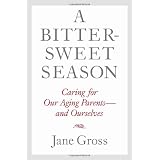
(More customer reviews)Are you looking to buy A Bittersweet Season: Caring for Our Aging Parents--and Ourselves? Here is the right place to find the great deals. we can offer discounts of up to 90% on A Bittersweet Season: Caring for Our Aging Parents--and Ourselves. Check out the link below:
>> Click Here to See Compare Prices and Get the Best Offers
A Bittersweet Season: Caring for Our Aging Parents--and Ourselves ReviewThis is a memoir about the final years in the life of the author's mother - AND a guide to the Rube-Goldberg-like complexities of Medicare, Medicaid, assisted living facilities (great for those who need no assistance), and nursing homes.It's about how the system is broken - a ridiculous maze of conflicting and unrealistic rules that (unsuccessfully) try to make a for-profit health care system humane.It's also about how, as Phillip Roth put it, "Old age isn't a battle - it's a massacre."The number one killer in the US is heart disease - number two is cancer. After a motley assortment of other diseases causing "early" death, we are left with that large group where everything is wearing out but the body refuses to die.This group is subjected to endless serial humiliations - physical and financial.Even if older couples enter their golden years with a million dollars they can die bankrupt and on Medicaid.Enlightened ones might even plan for it and give their assets away early. The wealthy and the destitute have less to worry about.
Gross definitely gets it right.My wife and I (mainly my wife - as Gross succinctly points out, the primary family rep is female at least 80% of the time), are going through this for the third and fourth times now. We have faced or are facing most of the issues she covers. Her chapter about Thanksgiving dinner in the nursing home (touching on a pecking order resembling a high school cafeteria) was perfect. She could have been describing our exact facility - with one dining room for those who could use a fork and another for those who required "feeders."In her words, "The elderly hate that you have to visit them in these surroundings on a holiday, so act like you're having a decent time even if you're not.Make it seem okay, but don't go overboard - that would insult their intelligence."
Gross emphasizes how important it is that families are heavily involved. The staff range from just OK to exemplary - but they have a lot of patients, many demands are placed on them, and the behavior of the patients (and sometimes the families) leaves a lot to be desired. The author's and her brother's constant tactful intervention (and help) resulted in consistently better care for their mother. My wife and I have used similar tactics and it makes a difference.I'll pass on a few instances where advocacy resulted in positive change:
First, when they figured out how to get re-authorization for Physical Therapy ("I'd love to be able to stand just one more time"), if just for an occasional session.She still had her mind but was completely stuck in a body that wouldn't work.
Second, when they figured out a way to get her qualified for a college-level writing class geared specifically for nursing home clientele. Problem is, a series of ministrokes had affected her speech and she couldn't manage the communication skills required for the class. Shortly after the first session started, she remarked, "I guess I can't do this either" - but it was one of the few group activities that attracted her interest. The author and her brother brainstormed and arranged this solution: a student intern who could understand their mom (through much practice) would wheel her out into the hall, take dictation, then wheel her back in and read her work to the class.
Third, when she could no longer speak at all, they came up with the "talking board." This was a recording console that had 30 big, easy to punch buttons. They programmed it with 28 recordings she could choose from to interact with nurses and staff. The last 2 buttons, they saved for their mom to have fun with.For 29, she decided on this response, appropriate for the occasional surly aide: "You'll be old too, someday, you know."The 30th button was outrageous: "Get the f___ out of my room."When she used that one on the persistent rabbi, the ice was finally broken and they became friends - communicating only on her non-religious terms.
In this kind and gentle memoir, you'll learn a lot about our health care system, how in old age less care can be better care, and that you need a primary care physician who gets the big picture (a geriatrician). After her mother's death, the author started a blogsite about "end of life" issues. It appears that the experience with her mother and that blogsite led to this book."Bittersweet Season" was surely a labor of love for this author. It was a pleasure to read and offers a wealth of resource material for anyone who has yet to face this very difficult part of life & death - and I recommend it highly.
A Bittersweet Season: Caring for Our Aging Parents--and Ourselves Overview
Want to learn more information about A Bittersweet Season: Caring for Our Aging Parents--and Ourselves?
>> Click Here to See All Customer Reviews & Ratings Now

0 comments:
Post a Comment