Average Reviews:

(More customer reviews)Are you looking to buy Inspire: Why Customers Come Back? Here is the right place to find the great deals. we can offer discounts of up to 90% on Inspire: Why Customers Come Back. Check out the link below:
>> Click Here to See Compare Prices and Get the Best Offers
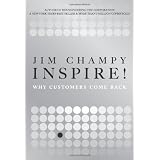
Inspire: Why Customers Come Back ReviewThose who read Jim Champy's previous book, Outsmart!, know that in it he drew metaphorically from Charles Darwin's theories of survival that are, and I quote, "Species always breed beyond available resources," "Those species with favorable variations have a greater chance of survival and pass on their variations to their offspring," and "Adapted species force out weaker ones, producing whole new species." These theories help us to understand the strategies of successful, fast-growing organizations. "Inspire! Picks up where Outsmart! leaves off, showing how these kinds of organizations have been able to increase their market share." In it he explains why customers come back to businesses that know how to deliver on their promises. "That is why the next book in the series will focus on how companies achieve true operational excellence. Like Outsmart! and Inspire!, it will have a simple, direct title: Deliver! That's because delivering is what every successful business does every day, in good times and bad."
Customer "satisfaction" is based on a single transaction and customer "loyalty" will continue from one transaction to the next only so long as each is satisfactory. Presumably Champy agrees with Ben McConnell and Jackie Huba that the objective should be to create customer evangelists who will not only "come back" but also bring others with them and, whenever possible and appropriate, function as an extended sales force. What will inspire customers to become evangelists? Champy suggests eight factors and devotes a separate chapter to each. Here are the first three:
1. Engage customers with a cause that will enable them "to identify with your mission and will happily pray a premium for the emotional connection they get from supporting it."
2. "An engagement strategy of convenience requires a deep understanding of how your product or service will fill a customer need. And what works for one group of customers might not work for another."
3. "Most companies don't [but should] give enough thought to their market channels and channel partners, and how those partners can enhance a customer experience."
The other five factors are simplifying complexity (as Albert Einstein once suggested, "Make everything as simple as possible...but no simpler."); being completely honest (i.e. authentic in that, what is affirmed and what is done are seamlessly consistent); interact with your company the same way your the customer does (i.e. "being your own customer"); balance enthusiasm with reality and, as Jason Jennings suggests, "nail the fundamentals" every time; and finally, re-energize product mix with unusual combinations (e.g. "cool and sport") that surprise and delight. In each chapter, Chapter provides a reader-friendly section, "Rules of Engagement," that I really appreciate. It consolidates specific considerations and suggestions for each of the eight factors. In the final chapter, for example, "What Could Be More Inspiring than the Melding of Cool and Sport?," six rules are provided and then briefly discussed: (1) Build on your past, (2) Don't try to go head-to-head with entrenched market leaders, (3) Use outsiders to challenge insiders, (4) Follow a well-marked highway but also test side roads now, (5) If you're the underdog play it up, and (6) Keep your edge authentic. Comparable rules are also provided near the conclusion each of the previous seven chapters. This reader-friendly device will facilitate, indeed accelerate review of key points later.
I am fascinated by the development of Champy's thinking about business process transformation since the appearance in 1993 of Reengineering the Corporation: A Manifesto for Business Revolution that he co-authored with Michael Hammer and then Reengineering Management: The Mandate for New Leadership three years later. I am among those who had then -- and still have -- reservations and concerns about any change initiative "systems" and methodologies that do not focus primarily on those responsible for their effectiveness. In his more recently published books, Champy seems to have become much more people-centered. (The same can also be said of Michael Hammer and Gary Hamel.) In Outsmart! And then in Inspire!, for example, Champy immediately establishes a personal rapport with his reader. The tone throughout both books is informal, almost conversational. "Here's what I think you need to consider. Now let's take a closer look. And as we proceed together, be sure to keep an eye open for...." This approach is especially appropriate in a book that offers information and advice about establishing and strengthening relationships with customers and channel partners, viewing them and treating them as valued human beings rather than as segments of an organizational equation.
Well-done!Inspire: Why Customers Come Back Overview
Want to learn more information about Inspire: Why Customers Come Back?
>> Click Here to See All Customer Reviews & Ratings Now

0 comments:
Post a Comment