Average Reviews:

(More customer reviews)Are you looking to buy America's Undeclared War: What's Killing Our Cities and How We Can Stop It? Here is the right place to find the great deals. we can offer discounts of up to 90% on America's Undeclared War: What's Killing Our Cities and How We Can Stop It. Check out the link below:
>> Click Here to See Compare Prices and Get the Best Offers
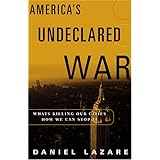
America's Undeclared War: What's Killing Our Cities and How We Can Stop It ReviewFirst a fair warning to readers. Any author who is called an "iconoclast" by his or her publisher will feel obliged to live up to the billing. So it is here with Daniel Lazare in AMERICA'S UNDECLARED WAR. The title alone should give an indication that he's ready for battle. He uses some heavy caliber firepower, when in ascribing blame for the demise of cities and the concomitant growth in the "culturally impoverished" suburbs, he says the following about the government. "The American system of limited government and fragmented political power allowed suburban communities to turn themselves into middle-class redoubts whose raison d'etre was to screen out blacks, Jews and anyone else deemed harmful to the municipal bottom line, while at the same time rendering cities powerless to fight back."Criticizing the government though does not make one an iconoclast; it's taken as a duty, whatever your political perspective. Conservatives are critical of the Great Society social welfare programs of the 1960's which they say fostered dependency, bred crime, and raised expenses; liberals blame the same government for massive highway construction, subsidized home mortage loans, and promoting the automobile, all of which spurred suburban growth.
Where Mr Lazare starts to live up to his billing as an iconoclast is in the vehemence with which he slams suburbia and with whom he blames for the origins of what he calls our "anti-urban bias". He says the decline of cities "was not urban decay but a form of urban manslaughter in which a wide array of social policies came together in such a way as to reduce one city after another literally to rubble. A combination of federal tax breaks and direct government outlays fueled suburban development at the expense of the cities." Who was to blame? Try our founding fathers whom Mr Lazare calls "a group of provincial politicians"; specifically Thomas Jefferson who developed a "concept of democracy as something intrinsically anti-urban."
The irony is that it is in the sections of the book where he is blasting away at the historical figures of the past - from Jefferson through to FDR - that he is also most interesting and comes up with a very original thesis. Mr Lazare states that there were two early settlement patters in colonial America that reflected city values. The close knit settlements of New England reflected the Puritan values of "Christianity not as a faith of lonely believers wandering in the desert but as a highly social religion revolving around the congregation and community." Also in Pennsylvania where practical considerations made for crowded waterfront developments. In contrast, Virginia with its irregular shoreline with many small inlets only helped to reinforce the anti-urban political culture characteristic of the "royalist Cavaliers" who settled there in small, scattered settlements dominated by plantations.
Where Mr Lazare sticks to developing on this theme and tying this historical bias to technological developments such as the automobile, his book is original and very readable. When he attacks traditions and institutions simply for the sake of being critical, the book comes across as contrived.America's Undeclared War: What's Killing Our Cities and How We Can Stop It Overview
Want to learn more information about America's Undeclared War: What's Killing Our Cities and How We Can Stop It?
>> Click Here to See All Customer Reviews & Ratings Now

0 comments:
Post a Comment